

OCCT (OverClock Checking Tool) is a hardware stability testing and monitoring utility for Windows developed by OCBASE. It allows users to stress-test CPUs, GPUs, memory, and power supplies while monitoring temperatures, voltages, fan speeds, and other hardware information in real time.
Originally designed for overclockers, OCCT is also useful for gamers, PC enthusiasts, technicians, and anyone who wants to diagnose hardware stability problems or verify system performance under heavy workloads.
Key Features
CPU Stress Testing: Runs demanding workloads on the processor to identify stability problems, overheating, and configuration errors.
GPU Stress Testing: Tests graphics card stability under heavy workloads and helps detect GPU-related errors.
Memory Testing: Places intensive workloads on system memory to help identify RAM errors and stability issues.
Power Testing: Combines CPU and GPU workloads to place a high load on the power supply and the overall system.
Combined Testing: Tests multiple components simultaneously to simulate demanding real-world workloads and identify system instability.
Real-Time Monitoring: Displays temperatures, voltages, fan speeds, frequencies, and other hardware sensors while tests are running.
Error Detection: Detects calculation and hardware-related errors during stress tests and helps identify potential stability problems.
Customizable Tests: Users can configure test duration, workload intensity, memory usage, and other parameters according to their needs.
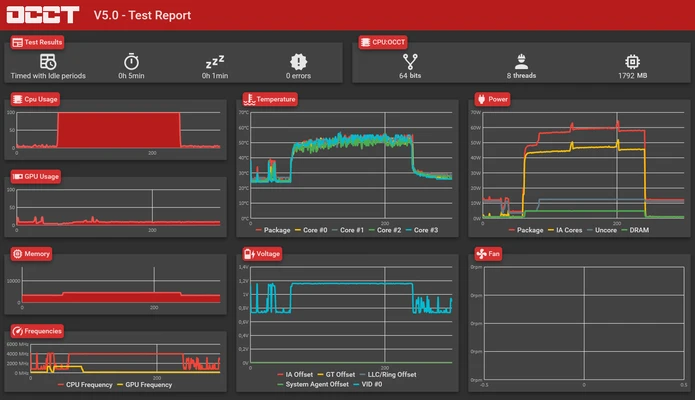
Monitoring Graphs: Displays hardware sensor information in real-time graphs and provides data for analyzing system behavior during testing.
Safety Monitoring: Configurable temperature, voltage, and fan-speed limits can automatically stop tests when potentially unsafe conditions are detected.
User Interface
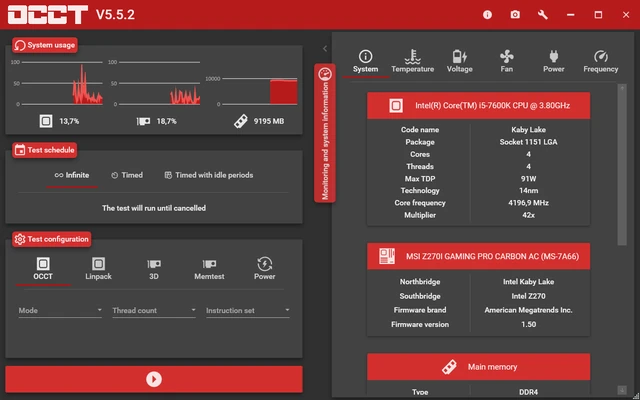
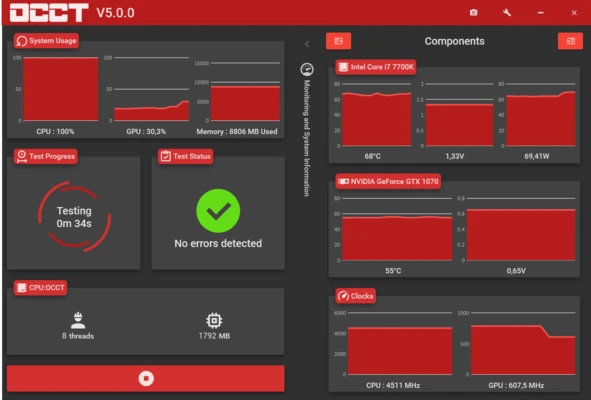
OCCT provides a modern interface that organizes its testing and monitoring functions into separate sections. Users can quickly select CPU, GPU, memory, power, or combined tests and configure the required parameters before starting.
During testing, the application displays real-time sensor information and graphs, allowing users to monitor system temperatures, voltages, fan speeds, and other performance data.
Installation and Setup
-
Download OCCT for Windows.
-
Run the installer and follow the setup instructions.
-
Launch OCCT after installation.
-
Allow the application to detect the available hardware and sensors.
-
Check the monitoring information before starting a stress test.
-
Select the component you want to test.
-
Configure the test duration and workload settings.
-
Start with a short test before running longer stability tests.
How to Use
Select a Test: Open OCCT and choose CPU, GPU, Memory, Power, or another available test.
Configure the Test: Adjust the duration, workload, memory usage, and other available parameters.
Start Testing: Click the Start button to begin the selected stress test.
Monitor Hardware: Watch temperatures, voltages, fan speeds, and other sensor readings while the test is running.
Check for Errors: Stop the test if abnormal temperatures, system instability, or hardware errors occur.
Review Results: Examine the test results and monitoring graphs after the test has finished.
For initial troubleshooting, short tests can help identify obvious problems. Longer tests are useful when verifying stability after hardware upgrades or overclocking.
FAQ
What is OCCT used for?
OCCT is used to stress-test and monitor computer hardware. It can help identify stability, overheating, and hardware configuration problems.
Can OCCT test a CPU and GPU?
Yes. OCCT provides dedicated tests for CPUs and GPUs as well as tests that can place a combined load on multiple components.
Can OCCT test RAM?
Yes. Memory testing is available for checking system RAM stability and detecting errors.
Can OCCT test a power supply?
Yes. Its power testing can place a heavy combined workload on the CPU and GPU, helping users evaluate system stability under high power consumption.
How long should an OCCT test run?
The appropriate duration depends on the purpose of the test. Short tests can be useful for quick troubleshooting, while longer tests are better for verifying system stability.
Can OCCT damage my hardware?
OCCT is designed for stress testing, but it deliberately places heavy workloads on hardware. Users should ensure that the system has adequate cooling and should stop testing if temperatures or other readings become unsafe.
Is OCCT free?
OCCT offers a free version with core testing and monitoring capabilities. Paid versions provide additional features for users who need more advanced functionality.
Alternatives
Prime95: A popular CPU stress-testing utility commonly used for stability testing and overclocking.
FurMark: A GPU-focused stress-testing tool designed to place heavy workloads on graphics cards.
AIDA64: A comprehensive system diagnostics and benchmarking application with hardware monitoring and stability testing features.
MemTest86: A dedicated memory diagnostic tool for detecting RAM-related problems.
IntelBurnTest: A CPU stress-testing utility designed to quickly expose processor and system instability.
Pricing
OCCT provides a free version with essential hardware testing and monitoring features. Paid versions are available for users who require additional testing and monitoring capabilities.
System Requirements
-
Operating System: Windows 7, Windows 8, Windows 10, or Windows 11
-
Processor: Intel or AMD processor
-
Memory: 2 GB RAM minimum
-
Graphics: Compatible GPU required for GPU testing
-
Storage: At least 100 MB of free disk space
-
Additional Requirements: Hardware monitoring features depend on the sensors supported by the system
PROS
-
Comprehensive CPU, GPU, memory, and power testing
-
Real-time hardware monitoring
-
Detailed monitoring graphs and test results
-
Customizable stress-test parameters
-
Useful for troubleshooting system stability
-
Suitable for both beginners and experienced users
-
Free version available
CONS
-
Stress tests can generate very high system temperatures
-
Some advanced features require a paid version
-
Not necessary for users who only need basic hardware monitoring
-
Incorrectly configured stress tests can place significant load on hardware
Conclusion
OCCT is a powerful hardware stability testing and monitoring tool for Windows. It combines CPU, GPU, memory, and power testing with real-time monitoring and error detection, making it useful for troubleshooting unstable systems and verifying hardware configurations.
The free version provides enough functionality for many home users, while advanced users can use additional testing and monitoring features when more detailed hardware analysis is required.