

Multi Commander is a free, feature-rich file manager for Windows designed as an alternative to the standard File Explorer. It is aimed primarily at power users who need more control over file operations, navigation, customization, and automation.
Its dual-panel interface makes it easy to work with files between two directories, while tabs, batch operations, customizable shortcuts, scripting, and built-in utilities provide additional flexibility.
What's New
Recent versions of Multi Commander focus on compatibility, stability, performance, and improvements to file management tools.
-
Improved compatibility with modern Windows versions.
-
Performance and stability improvements.
-
Updates to file copy, move, and rename operations.
-
Improvements to tab and panel management.
-
Updates to scripting and automation capabilities.
-
Improvements to file preview and metadata handling.
-
Bug fixes and general user-interface improvements.
Key Features
-
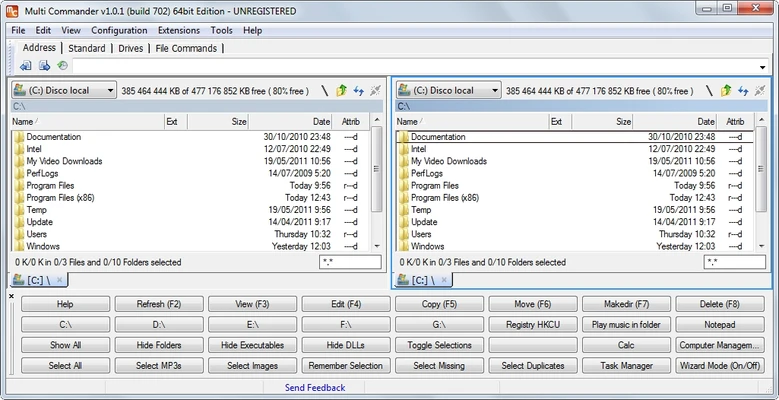
Dual-panel interface allows users to view and manage two directories simultaneously.
-
Tabbed browsing makes it possible to keep multiple folders open within the same window.
-
Advanced file operations support copying, moving, deleting, renaming, and comparing files.
-
Batch renaming makes it easier to rename large numbers of files at once.
-
Copy and move queues help organize multiple file-transfer operations.
-
File comparison makes it easier to identify differences between files or folders.
-
Built-in archive tools provide access to supported compressed files.
-
FTP support allows users to work with files on remote FTP servers.
-
File preview provides quick access to supported documents, images, and media files.
-
Metadata viewing displays available information for supported file types.
-
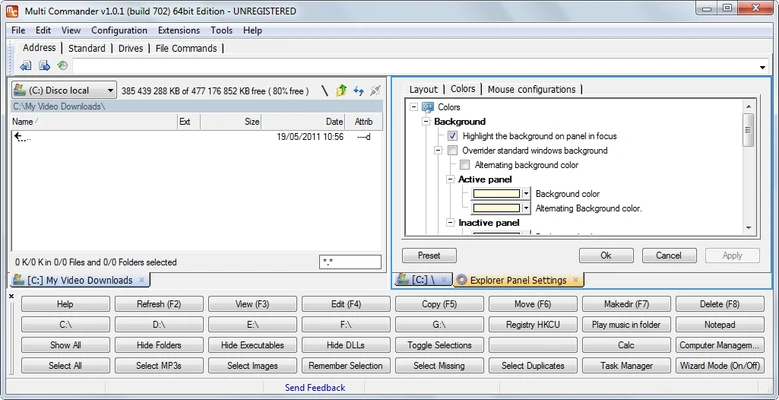
Customizable interface allows users to modify panels, toolbars, colors, and other visual elements.
-
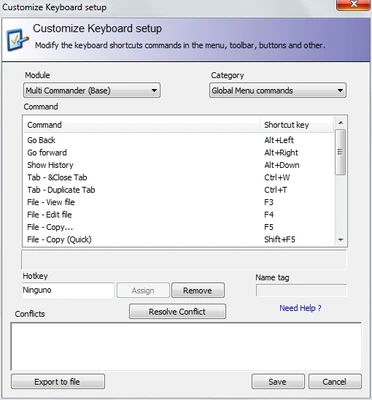
Keyboard shortcuts provide fast access to frequently used operations and can be customized.
-
Scripting and automation allow repetitive tasks to be automated using MultiScript and supported external scripting methods.
-
Portable version allows the program to run without a traditional installation.
-
Built-in utilities provide additional tools for managing files and Windows-related tasks.
User Interface
The Multi Commander interface is based around a dual-panel layout. Each panel can display a different directory, making it convenient to copy or move files between locations.
Tabs allow multiple directories to remain accessible without opening additional windows. Toolbars, panels, colors, and keyboard shortcuts can also be customized to match different workflows.
The large number of available options can make the interface appear complicated to users who are accustomed to Windows File Explorer, but experienced users can configure it to work efficiently with keyboard shortcuts and customized layouts.
Installation and Setup
Multi Commander is lightweight and can be installed quickly on Windows.
-
Download the appropriate version for your Windows system.
-
Run the installer and follow the setup instructions.
-
Choose the desired installation options.
-
Launch Multi Commander after installation.
-
Configure the panels, toolbars, colors, and shortcuts according to your preferences.
-
If preferred, use the portable edition instead of installing the application.
The initial configuration can be kept simple, with advanced options available for users who want to customize their workflow.
How to Use
-
Navigate folders: Use either panel to browse drives, folders, and network locations.
-
Manage two directories: Use the dual-panel layout to copy or move files between locations.
-
Open folder tabs: Create tabs for frequently used directories.
-
Copy or move files: Select files and use the appropriate file-operation commands.
-
Rename multiple files: Use the batch-renaming tools to process groups of files.
-
Compare files: Use the comparison functions to identify differences between files or folders.
-
Access remote files: Configure an FTP connection when working with files on an FTP server.
-
Preview files: Use the built-in preview functionality to inspect supported files without opening another application.
-
Customize shortcuts: Configure keyboard shortcuts for frequently used operations.
-
Automate tasks: Use MultiScript or supported external scripting methods to automate repetitive operations.
-
Manage archives: Use the built-in archive functionality to work with supported compressed files.
FAQ
Is Multi Commander free?
Yes. Multi Commander is free to use.
Does Multi Commander have a portable version?
Yes. A portable version is available and can be run without a traditional installation.
Does Multi Commander support dual-pane file management?
Yes. The dual-panel interface is one of its main features and allows users to work with two directories at the same time.
Can I customize keyboard shortcuts?
Yes. Multi Commander provides extensive keyboard shortcut support and allows users to customize shortcuts for different operations.
Does Multi Commander support scripting?
Yes. It provides MultiScript and support for external scripting methods, allowing advanced users to automate repetitive tasks.
Does Multi Commander support FTP?
Yes. The application includes FTP functionality for accessing and managing files on compatible remote servers.
Does Multi Commander support cloud storage?
Multi Commander provides FTP support but does not function as a dedicated cloud-storage client with native integrations for services such as Google Drive or OneDrive.
Can Multi Commander replace Windows File Explorer?
Yes. It can be used as an alternative file manager for everyday file operations, although its extensive features and dual-panel design are primarily aimed at users who want more control than the standard Windows File Explorer provides.
Alternatives
Total Commander – A powerful dual-panel file manager with extensive plugin and customization support.
Directory Opus – An advanced Windows file manager with a highly customizable interface and extensive functionality.
FreeCommander – A free file manager with dual-panel navigation and many advanced file-management features.
XYplorer – A feature-rich tabbed file manager with strong search, navigation, and customization capabilities.
Far Manager – A keyboard-oriented text-based file manager suited to advanced users and command-line workflows.
Pricing
Multi Commander is free to use. There is no subscription or paid license required for the standard application.
System Requirements
-
Windows 7, Windows 8, Windows 10, or Windows 11
-
32-bit or 64-bit Windows
-
At least 1 GB of RAM
-
Approximately 50 MB of free disk space
-
Modern Intel or AMD processor
The program is lightweight and generally requires few system resources compared with more heavily featured desktop applications.
Pros
-
Free to use
-
Lightweight and efficient
-
Powerful file-management tools
-
Dual-panel interface
-
Tabbed folder navigation
-
Extensive customization options
-
Batch file operations
-
Scripting and automation support
-
FTP functionality
-
Portable version available
Cons
-
Interface can be overwhelming for beginners
-
Requires some learning to use advanced features effectively
-
Native cloud-storage integration is limited
-
Visual design may feel dated compared with some newer file managers
Conclusion
Multi Commander is a capable Windows file manager designed for users who need more functionality than the standard File Explorer provides. Its dual-panel layout, tabs, batch operations, customizable shortcuts, FTP support, scripting capabilities, and portable version make it particularly useful for power users.
While the extensive configuration options can create a learning curve for beginners, users who regularly perform complex file-management tasks can benefit from its flexibility and automation features. For those looking for a free and highly customizable alternative to Windows File Explorer, Multi Commander is a strong choice.